History of Promontory PointEarly History
Promontory Point park, located on the shore of Lake Michigan between 53th and 57th Streets, extends for 4,200 linear feet of shoreline on Chicago's South Side. The Point is a 40-acre, man-made peninsula at the south end of Chicago’s 600-acre Burnham Park. Promontory Point begins west of the 55th Street tunnel along Stony Island Boulevard, and resumes east of the tunnel along the lakefront. When landfill operations to create the southern part of Burnham Park commenced in 1922 , Promontory Point began construction shortly after and was generally finished by May 1938. Originally, a rock platform was built in 1926 around the 4,200 foot perimeter and, later in 1937-38, the existing limestone block, step-stone revetment was constructed as a WPA project that paved the entire Chicago lakefront with limestone blocks. This limestone revetment consists of a promanade at water's edge with four or five tiered step stones rising to the parkland. Promontory Point hosts the only remaining section of the original WPA limestone revetment. A cement platform was added in the early 1960s to the east end and is called the coffins. |
|
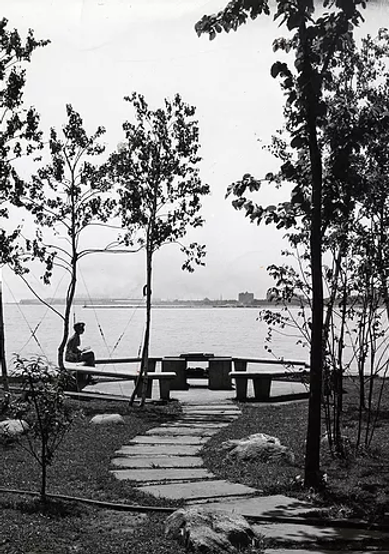
Landscape architect Alfred Caldwell created the Point’s Prairie Style landscape and Council Rings. Architect Emanuel V. Buchsbaum designed its French eclectic-style towered field houase and pavilion that is sometimes likened to a lighthouse. In 1989, Caldwell worked with the Chicago Park District to oversee the revitalization of Promontory Point’s landscape. Shortly thereafter, the Park District rehabilitated the historic pavilion.
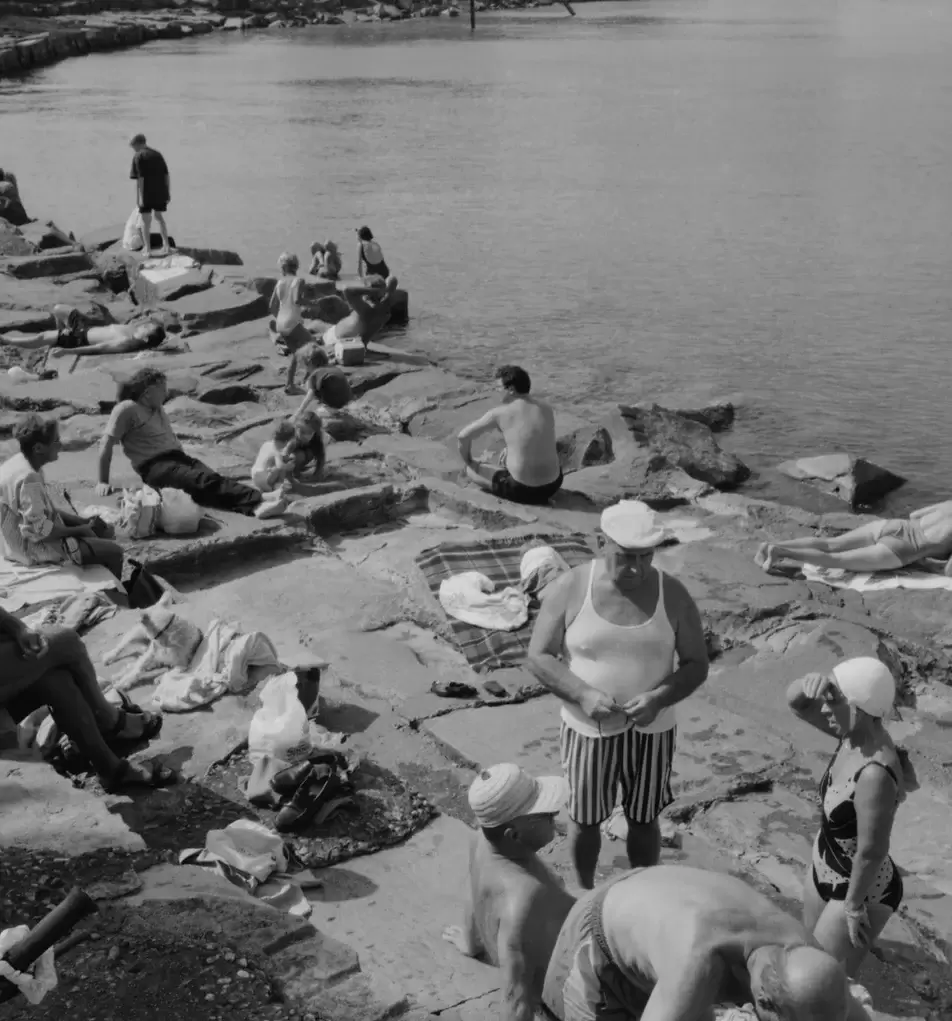
Throughout its hundred year history, Promontory Point is a very popular place for reflection, deep water swiming, strolling and picnics with its impressive views of the Chicago lakefront wilderness, Lake Michigan, and downtown Chicago. People come from all over the City to enjoy the Point.
|
Recent History
After high lake levels in the 1980s, the Chicago Park District, City of Chicago (CDOT), and U.S. Army Corps of Engineers worked together to develop a $300 million plan to repair and replace the aging revetments along the city’s entire lakefront. This plan called for repair and/or replacement of the revetments as originally built with limestone blocks. However, when construction began on the lakefront in Lincoln Park, the limestone revetments were replaced by tiers of concrete instead. In 2000, the Park District and the City’s Department of the Environment presented preliminary plans for proposed changes to Promontory Point’s revetments. The officials “told residents there was no way to save the limestone—the rocks were crumbling under pressure from the water.” Many of the Hyde Parkers at the meeting strongly believed that the step-stone revetments were a critical element of Promontory Point’s historic landscape. They were aware that the limestone revetments had been repaired in the past, and they believed they could be saved. |
The following year, the community formed a task force, raised funds, and hired coastal engineer Cyril Galvin, to conduct a feasibility study to determine whether preserving the step-stone revetments could be a viable option. Galvin’s report determined that revetment repairs could be undertaken in a manner that preserves the step-stone edge. At this time, the government agencies intended to move forward with the concrete option. However, the State Historic Preservation Office did issue a letter of no adverse effect for the concrete plan at Promontory Point in June 2002 which stopped demolition plans.
By 2006, many groups rallied together to call for an alternative construction option that would save the step-stone revetments. The Promontory Point Task Force received support from several organizations including Hyde Park Historical Society, Landmarks Illinois, and the National Trust for Historic Preservation, as well officials such as U.S. Congressman Jesse Jackson, Jr., and then U.S. Senator Barack Obama. As a result of several meetings held in 2006 and the strong public support for a preservation approach, the government agencies agreed concensus on a Scope of Work and alternative preservation plans would be prepared. However, as of 2021, no Federal or State funding was earmarked so work at the Point stalled out indefinitely.
Despite its deteriorating but still functioning revetment and somewhat sparser plantings, Burnham Park’s Promontory Point remains one of the most significant historic landscapes on the lakefront and most beloved spots on the city’s South Side. Caldwell said that Promontory Point was “a place you go to and you are thrilled— a beautiful experience, a joy, a delight.” Without question, Promontory Point remains such a place today.
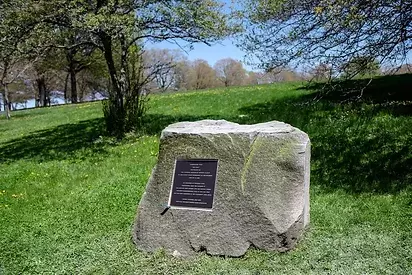
The National Register of Historic PlacesIn 2017, the Promontory Point Conservancy (formerly Save The Point) applied for a U.S. National Register of Historic Places listing for Promontory Point. More than 80,000 significant historic sites across the nation are honored on the Register. We felt the Point was worthy of this designation for its historic features such as the unique limestone, step-stone revetment, the Caldwell Council Rings and landscaping. The Conservancy raised funds needed for the preparation of the National Register application and, once awarded, for the plaque in a limestone block and its location on the east side of the Point.
|
|
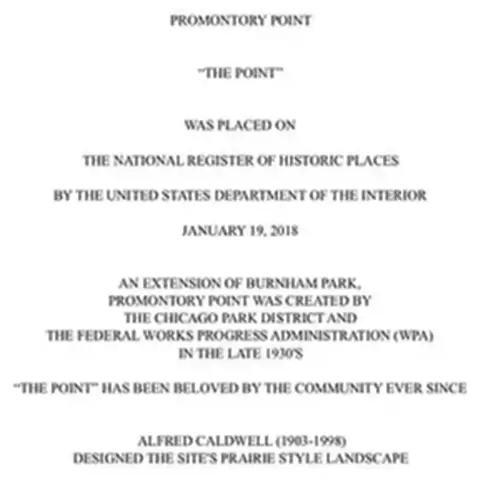
In September of 2017, the application was reviewed by the Commission on Chicago Landmarks where it passed unanimously. The nomination then went to the Illinois Historic Preservation Agency in Springfield in October 2017 where it was unanimously approved and passed on to the U.S. Department of the Interior’s National Park Service. On January 19, 2018 Promontory Point Park was listed on the National Register of Historic Places.
|
The Register listing highlights the Point’s limestone revetment that meets Lake Michigan, its Alfred Caldwell designed landscape, and its long history as an open and safe place for all to meet, mingle, swim, sit, stroll and play. This listing on the National Register honors the Point’s history, beauty and diversity. It also helps preserve the Point for future generations.
Although protection of the Point's historic features is not guaranteed, any proposed construction projects at the Point that involve federal money or federal permits will need to demonstrate that construction will not have an adverse effect on the historic character of the Point before work begins. In September 2021, Promontory Point was suggested for City Landmark status from the Commission on Chicago Landmarks. |
|
With high lake levels and lakefront park erosion in winters 2017-2020, the Chicago Park District, the City (CDOT) and the US Army Corps of Engineers began efforts to complete the uncompleted work from 1996-2006 at Promontory Point. However, the City's locally "preferred design of the revetment is vertical steel sheet piles to replace the damaged wood piles, and concrete steps and promenade to replace the existing stones" and purports to preserve "its historical and aesthetic value".
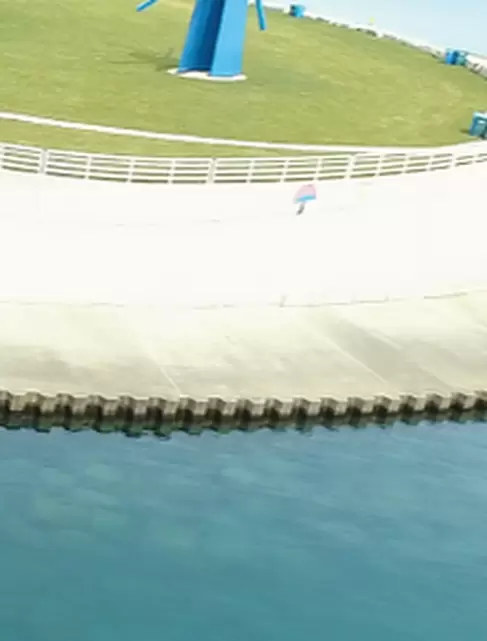
The City and Park District's plan actually violates a true preservation approach, the rehabilitation and repair required by the National Historic Preservation Act, and the community's wishes for preservation. So Promontory Point Conservancy again rallies the community and works with elected officials to Save the Point Again! CDOT's BRIC Pre-application for FEMA funding, September 30, 2020, exhibits the concrete promenade at Diversey Harbor with decorative limestone seats as CDOT's design for new construction for Promontory Point. |
|

|
CPD & CDOT: Don’t destroy Promontory Point!Here’s the work we already did to get here
For over 20 years, the South Side community has worked to save Promontory Point’s limestone revetment from being demolished and replaced with concrete. |
In 2002, the Chicago Park District (CPD) and the City (CDOT) put forward a “concrete/compromise” design that would have demolished the limestone revetment, replaced it with concrete, leaving only an ornamental row of stones at the top and severely restricted access to the water. The community rejected this plan.
In 2002-2004, as Save the Point, the community funded its own engineering design studies that demonstrated the historic limestone revetment could be restored. In fact, it was:
The US Army Corps of Engineers' Preservation Center weighed in, agreeing with the community-funded engineering report that the limestone could be restored and at less or the same cost as demolition and concrete. And in 2002, SHPO, Illinois Historic Preservation Office, issues a letter of adverse effects rejecting the City's concrete and steel plan.
In 2006, then-Senator Obama stepped in and started a new design process that would ensure restoration of the Point with:
This process was stalled out by the City even though Promontory Point Conservancy continued to meet and talk regularly with governmental agencies and elected officials.
In 2017, Promontory Point was added to the National Registry of Historic Places for its distinctive and unique limestone revetment and people’s decades of enjoyment there. This sets Federal guidelines that protect the limestone revetment from demolition.
In 2002, the Chicago Park District (CPD) and the City (CDOT) put forward a “concrete/compromise” design that would have demolished the limestone revetment, replaced it with concrete, leaving only an ornamental row of stones at the top and severely restricted access to the water. The community rejected this plan.
In 2002-2004, as Save the Point, the community funded its own engineering design studies that demonstrated the historic limestone revetment could be restored. In fact, it was:
- cheaper than demolition and new construction of concrete and steel
- studier and more durable than the concrete found on the rest of the City lakefront
- much more accessible and inclusive with ADA adaptation
The US Army Corps of Engineers' Preservation Center weighed in, agreeing with the community-funded engineering report that the limestone could be restored and at less or the same cost as demolition and concrete. And in 2002, SHPO, Illinois Historic Preservation Office, issues a letter of adverse effects rejecting the City's concrete and steel plan.
In 2006, then-Senator Obama stepped in and started a new design process that would ensure restoration of the Point with:
- maximum historic limestone;
- minimum concrete; and
- safe and generous access (ADA compliance) for all to both the revetment and the water
This process was stalled out by the City even though Promontory Point Conservancy continued to meet and talk regularly with governmental agencies and elected officials.
In 2017, Promontory Point was added to the National Registry of Historic Places for its distinctive and unique limestone revetment and people’s decades of enjoyment there. This sets Federal guidelines that protect the limestone revetment from demolition.
Here’s the current situation at the Point — Save the Point Again!
CPD and CDOT have used the rising lake levels and storm erosion in 2017-2019 to create a false emergency at Promontory Point. The erosion at the Point does not affect Lake Shore Drive or endanger private property or human life. And current data show lake levels falling rapidly due to drought.
One year ago, the CDP and CDOT began preliminary engineering studies, planning and funding requests to replace the limestone revetment with new construction of concrete and steel — without consulting the community, other governmental agencies or elected officials, and in violation of the original 1993 Memorandum of Agreement and the National Register standards. Authority to move the Point forward has now transferred to the US Army Corps of Engineers Chicago with imminent federal funding.
Right now, we know:
US ACE, CDP & CDOT: Don’t restart the clock! Let’s pick up right where we left off!
CPD and CDOT have used the rising lake levels and storm erosion in 2017-2019 to create a false emergency at Promontory Point. The erosion at the Point does not affect Lake Shore Drive or endanger private property or human life. And current data show lake levels falling rapidly due to drought.
One year ago, the CDP and CDOT began preliminary engineering studies, planning and funding requests to replace the limestone revetment with new construction of concrete and steel — without consulting the community, other governmental agencies or elected officials, and in violation of the original 1993 Memorandum of Agreement and the National Register standards. Authority to move the Point forward has now transferred to the US Army Corps of Engineers Chicago with imminent federal funding.
Right now, we know:
- the historic limestone revetment can be restored and we believe it more cost-effective than new construction
- community participation leads to good results for all
- the 2006 Obama process needs jumpstarting and will get us where we want to go
US ACE, CDP & CDOT: Don’t restart the clock! Let’s pick up right where we left off!
Vanishing Point: the City's "locally preferred plan"
As it currently stands, the City's “locally preferred plan” is demolition of the limestone revetment and new construction of textured concrete and steel. This is what the City (CDOT) and the Chicago Park District (CPD) plan for the Point. We know that's what CDOT and CPD are planning from public information.
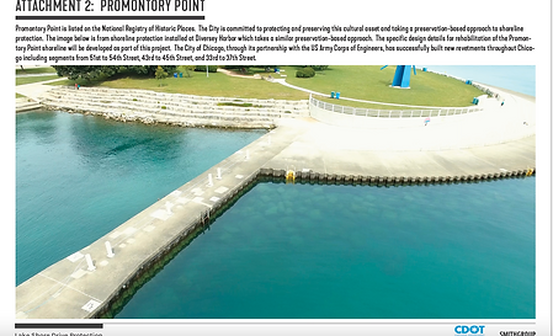
First, on CDOT’s Shoreline Protection Project webpage , CDOT clearly states what the “locally preferred plan” is and what they mean by preservation:
First, on CDOT’s Shoreline Protection Project webpage , CDOT clearly states what the “locally preferred plan” is and what they mean by preservation:
|
“The preferred design of the revetment is vertical steel sheet piles to replace the damaged wood piles, and concrete steps and promenade to replace the existing stones. This design maintains safe access to the shoreline while preserving its historical and aesthetic value.” (Promontory Point and Morgan Shoal are included in "Reach 4-step stone revetment reconstruction from 23rd Street to 57th Street alongside Lake Shore Drive” on the same webpage.)
Through FOIA, we also obtained CDOT’s BRIC FEMA pre-application dated September 30, 2020. On page four of the exhibits, CDOT clearly states and illustrates what it means by preservation at Promontory Point: a new revetment of textured concrete (faux limestone) and steel with decorative limestone blocks in the parkland." |
|
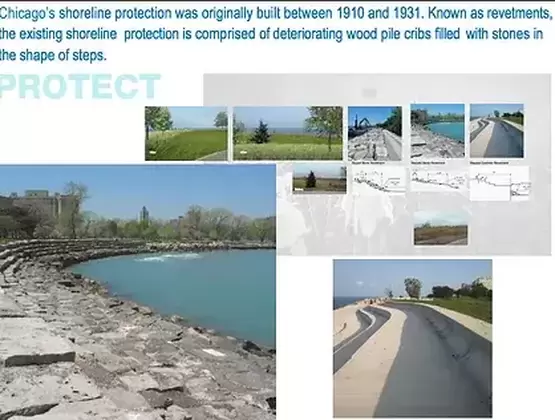
Finally, at the Public Building Commission’s information session for potential bidders on the Morgan Shoal Project, May 18, 2021, CDOT pictured Promontory Point and stated its preferred plan of concrete and steel to replace the historic step-stone, limestone revetment: All chilling evidence that the City's “locally preferred plan”, as it stands, is NOT a preservation approach. It violates the Secretary of the Interior Standards for repair and rehabilitation of the historic limestone revetment at the Point and it ignores the community's preferred plan of preservation. So, Mayor Lightfoot’s recent statements about preservation at the Point at the press conference on 2/4 about infrastructure funding for Chicago's lakefront concern us: we know what the City means by preservation, and that’s NOT what we all want. |
|
As it stands, the City's "locally preferred plan" is NOT the plan:
- advocated by Promontory Point Conservancy
- supported by the community at large
- endorsed by U.S. Congresswoman Robin Kelly
- favored by IL Senator Robert Peters who has written letters supporting City-landmarking and insisting on a preservation approach that restores and rehabilitates the historic limestone revetment at the Point, and
- supported by Alderman Leslie Hairston who has made public statements for City-landmarking at the Point to stop demolition and championed preservation at the Point for over twenty years
Textured concrete (faux limestone) is NOT real preservation, and demolition and new construction are NOT legal under the Secretary of the Interior's Standards for Archaeology and Historic Preservation and the Standards for Rehabilitation of Historic Buildings which includes cultural assets such as landscapes and revetments.
|
Destination Point: A Preservation ApproachPromontory Point Conservancy advocates for a legally mandated preservation approach for the repair and rehabilitation of the historic limestone revetment at the Point. The limestone revetment at the Point has done an outstanding job for its 84-year life and still functions with little care and maintenance in its lifespan. Without much maintenance over its long history, however, it is slowly eroding and needs restoration. The northeast section with the concrete coffins, modifications made in the early 1960s, is deteriorating more rapidly where wave action eroded a small portion of the landfill and the CPD poured concrete filler.
|
Overtopping waves have eroded grass on the immediate landslide of the revetment on the northeast and north sections, and undermined the coffin promonade causing the limestone to tip backward. Along the south stretch, erosion is minimal and the limestone blocks can be repaired-in-place.
We already have a design concept for the Point: the construction of the Point itself, self-evident if you walk the Point. The Point’s revetment was designed 84 years ago to protect parkland behind it from the impacts of wave energy and associated erosion. This ingenious, original design can be repaired and rehabilitated with a preservation approach and does not have to be demolished and replaced with new construction of concrete and steel (the City's "locally preferred plan).
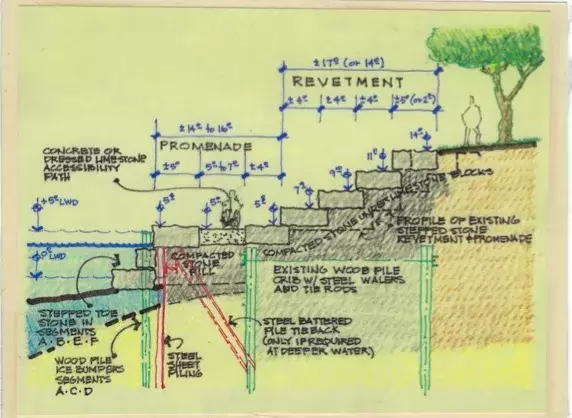
From 2002-2004, the community funded multiple engineering studies to show preservation is doable and may even be cheaper. The studies illustrate different creative approaches to repair-in-place and adaptation for ADA complicance. As shown below, new steel sheet piling with stepped-toe stones, resetting of some stones and substrate repairs for others can be completed as repair-in-place work, certainly along the south stretch of the Point. In other places such as the north stretch, stones can be reset without deconstructing the entire area.
Preservation is "cheaper, stronger and better looking" than demolition and new construction (the City's "locally preferred plan"). In 2002-2004, the community funded its own design engineering studies (2002 Galvin Report, 2003 Shabica-Tjaden-Heiztman Preservation Plan and Cost Estimate, 2004 Kalven Mediator’s Report with Bruxnell) that repeatedly showed that a preservation approach with adaptation for ADA compliance was entirely feasible and significantly cheaper. Our early discussions in 2021 with national marine engineering firms confirm the findings of the 2002-2004 studies, despite additional erosion over the past 17 years, notably:
- Repair and rehabilitation-in-place is significally cheaper than demolition and new construction of steel and concrete
- The limestone revetment is more durable with a lifespan of 85 years versus 35 years for concrete and requires less maintenance costs over a longer lifespan. Plus the limestone blocks have already weathered 40 million years, plus or minus
- Three-quarter of the limestone blocks can be repurposed and reset rather than using all new materials as with the City's "locally preferred plan" of demolition and new construction of concrete and steel. Repurposing existing materials (limestone blocks) does not create the environmental hazards and does not contribute to climate change as the use of concrete for new construction would
- Construction can be completed quicker as sections could be repaired in place, such as the entire south side, without closing the entire park for 3-5 years as would happen with demolition and new construction (the City's "locally preferred plan")
- Preservation is the community’s preferred plan because it is aesthetically more pleasing and providing continuous access to the water at a time of higher temperatures and climate changes
- Creative adaptation of a preservation approach for ADA compliance is also feasible, inclusive and embraced by the community. Thoughtful ADA complaiance would minimize concrete and maximize the existing limestone
- With a preservation approach, the traditional open swimming practices at the Point will continue and even be enhanced
We also know that these preservation methods can be engineered and executed because of multiple National Park Service projects to repair and rehabilitate historic sea walls and revetments under construction right now. Ellis Island is a premier example of preservation of a historic revetment/sea wall at work.
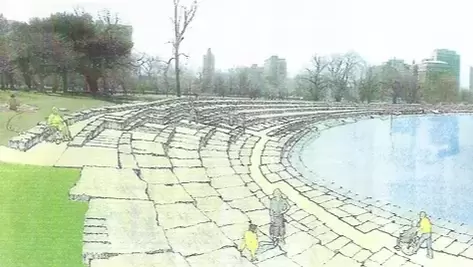
Preservation with creative ADA adaptation is good for the community. Preservation standards allow for adaptation for ADA compliance. Good preservation must incorporate -- in a harmonious way -- changes for safety and accessibility. If you visit Abraham Lincoln's boyhood home, for example, you will find electric lights throughout that do not destroy the historic nature of the site. At the Point, creative adaptation for ADA compliance offers inventive possibilities for the City and Park District to work with the Conservancy and its engineers to find aesthetically viable ways for people to get to the revetment and the water, and into the water without destroying the historic limestone revetment and its unique aesthetic.
|
The Conservancy hears from folks in wheelchairs and their families that they want smoother parkland pathways, level entrances to restrooms and easy access to the promenade and the water. A preservation approach promises these solutions. The above illustration offers only a single adaptation for ADA compliance and invites other creative, thoughtful possibilities that minimize concrete and maximze limestone.
|